

Fall Lawn Care in Peoria: Your November Checklist
It is the second week of November in Peoria. The maples on your street dropped everything in one windy weekend. Your lawn is half buried, the grass is still green underneath, and the forecast shows the first real cold snap. You missed the September aeration window. Now you wonder if fall lawn care in Peoria is already over for the year.
It is not over. It just looks different in November. Some jobs still matter a lot right now. Others should wait until next fall, and doing them now wastes money. This guide sorts the two. That way, your next few weekends go to work that shows up as a greener lawn in April.
What this checklist covers
You will get a week-by-week plan for November and early December. It is built for Peoria clay, bluff-side slopes and freeze-thaw winters. It covers the last mow, late-fall fertilizer, leaves, dormant seeding, weeds, sprinklers, snow mold and road salt. It also covers local costs and the mistakes we see most around town.
Once snow arrives, protect the grass along your curb with our guide to road salt damage and how to prevent it.
The advice leans on research from the University of Illinois Extension and the turf program at Purdue University. Where the experts disagree, we say so and tell you which way we lean.
Is it too late for fall lawn care in Peoria?
No. November is still a busy month for fall lawn care in Peoria. Your grass keeps growing roots until the soil freezes, usually in December. The last mow, a late nitrogen feeding, leaf cleanup and weed control all still help. Seeding and aeration are the two jobs that mostly have to wait.
Peoria lawns are cool-season grass. Most yards here are Kentucky bluegrass and tall fescue, with some perennial ryegrass mixed in. These grasses slow their top growth when nights get cold. Underground, they keep storing sugars and building roots for weeks. That hidden growth is what you are feeding and protecting now.
Here is the part most checklists skip. Peoria usually sees its first frost around the end of October, but the ground often stays workable well into December. That gap gives you more time than you think. It also tempts people into jobs that need warm soil, like seeding. More on that trap below.
What should you do first this week?
Start with leaves and the mower. Get thick leaf mats off the grass, then mow at a normal height while the lawn still grows. Fertilizer comes after your final mow. Sprinklers need to be drained before the first hard freeze. Everything else can follow in the order shown in the table below.
| When | Task | Why it matters |
|---|---|---|
| Now to Thanksgiving | Clear or mulch leaves every week | Thick mats smother grass and invite snow mold |
| Now to late November | Keep mowing at 3 inches | Grass still grows on mild days |
| Last mow of the year | Drop to about 2.5 inches | Shorter grass resists matting under snow |
| About a week after the last mow | Apply late-fall nitrogen | Feeds roots and gives an early green-up |
| Before the first hard freeze | Drain or blow out sprinklers | Frozen water cracks pipes and heads |
| Mild days above 50°F | Spot-spray broadleaf weeds | Weeds pull herbicide down to their roots |
| After Thanksgiving | Dormant seed thin spots if you want | Seed waits in the soil until spring |
How short should the last mow be?
Keep mowing at about 3 inches until growth stops, usually in mid to late November. For the final cut, drop to about 2.5 inches. Do not scalp the lawn. Cutting much lower stresses the crowns right before winter and opens the door to weeds next spring.
Tall grass flops over under snow. That wet, matted layer is where snow mold grows. A slightly shorter final cut stands up better. Going too short is the bigger risk, though. We see more damage from scalped lawns than from lawns left a little long.
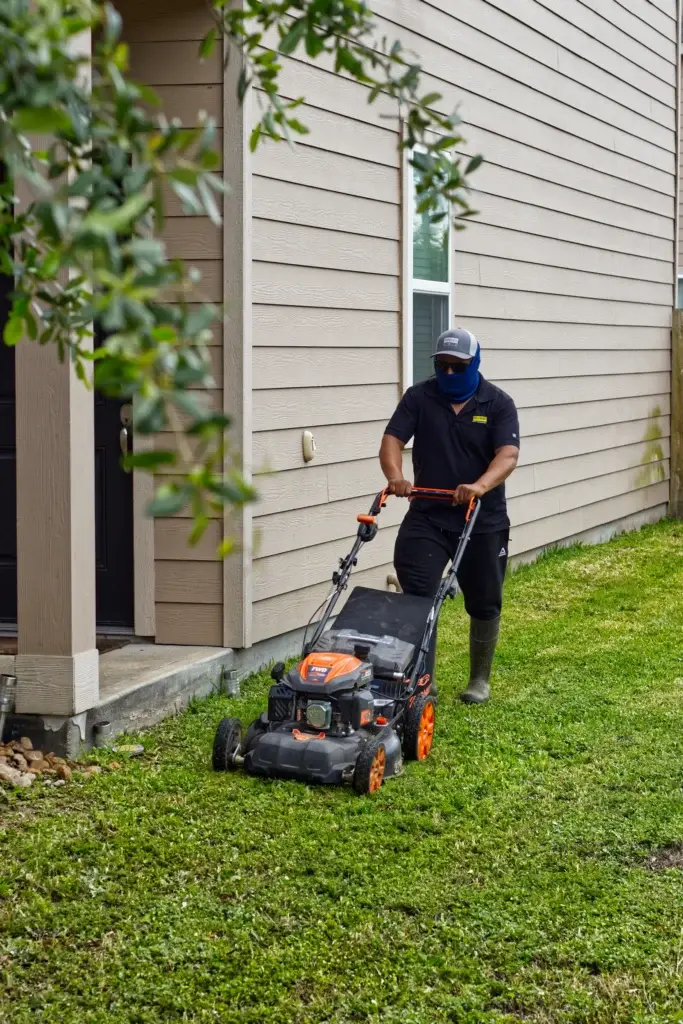
Sharpen the blade before the last few mows. A dull blade tears leaf tips, and torn tips turn brown and stay that way all winter. If you run a mulching mower, keep the leaves chopped fine on the same pass. Our mowing service page explains the height rules we follow through the season.
Should you fertilize your lawn in November?
Yes, if you fertilized in September too. The Purdue and Illinois lawn guide suggests one pound of nitrogen per 1,000 square feet. Apply it after your last mow, while the grass is still green. That feeding builds roots over winter. It also gives you a faster, greener start next spring.
This feeding goes by a few names. Some bags say winterizer. Some say fall or winter formula. What matters is the nitrogen. The joint Purdue and Illinois guide calls urea, a fast-release nitrogen, very effective this late in the year.
Which product should you buy?
- Urea (46-0-0) from a farm store is the cheapest way to get late-fall nitrogen. It needs careful spreading because it is strong.
- Scotts Turf Builder WinterGuard is easy to find at Peoria big-box stores. Check the bag, since some versions include weed killer.
- Milorganite is slow-release and gentle. It works poorly in cold soil, so it is a better September choice than a November one.
- Jonathan Green Winter Survival and similar blends add potassium. That helps, but nitrogen is still the main job.
Here is our honest take. A weed-and-feed winterizer is fine for a thick lawn. Skip it if you plan to dormant seed, because the weed killer can stop new grass from sprouting. And never spread fertilizer on frozen ground. It washes into storm drains and, from there, toward the Illinois River. Our fertilization and weed control page covers the full yearly schedule.
Should you leave leaves on the lawn or rake them?
Mulch light layers and remove heavy ones. If you can still see grass through the leaves, run a mulching mower over them and leave the bits. If leaves cover the lawn like a blanket, rake or blow them off. A thick mat left over winter can kill grass and leave bare patches by April.
University of Illinois Extension points to Michigan State research showing that shredded leaves can feed a lawn. So the old rule of raking every leaf is outdated. The catch is volume. A big oak or silver maple on a North Peoria lot drops far more than a mower can shred.
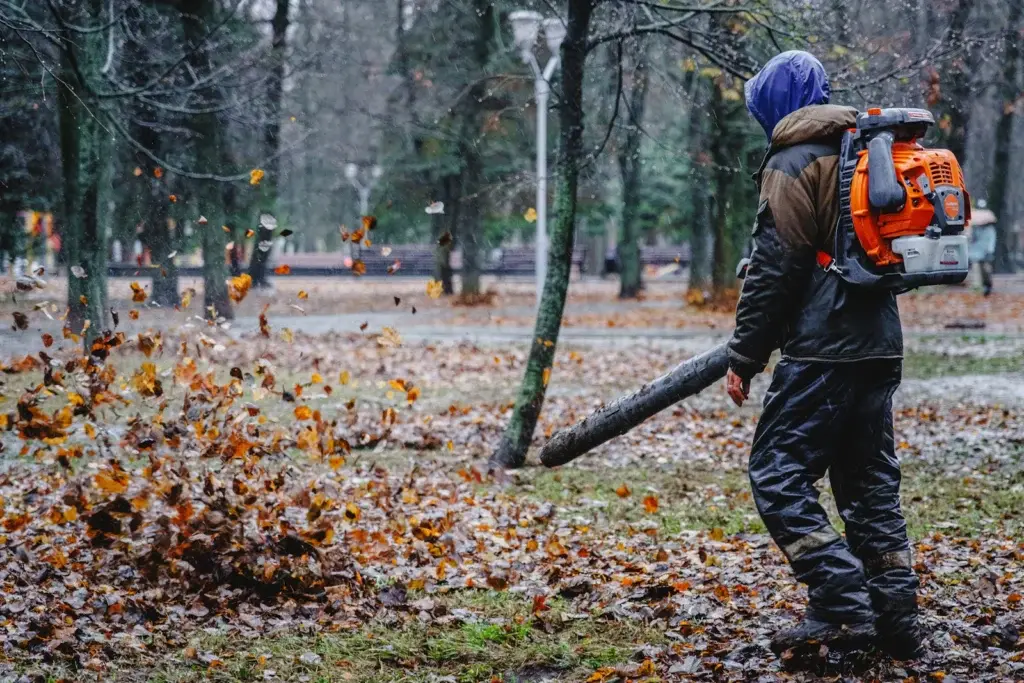
Timing matters with the city, too. For 2026, Peoria weekly yard waste pickup runs through the week of December 7. Check the rules for bags and brush bundles in our Peoria yard waste guide. Extra leaves also make good mulch in garden beds. If the job is too big for a weekend, our leaf removal service handles it.
Can you still seed grass in November?
Not with a normal seeding. Seed sown in early or mid November may sprout on a warm week and then die in the cold. A better option is dormant seeding after Thanksgiving, once the soil is too cold for seed to sprout. You can also wait until spring or next fall.
This is the trap we mentioned. Purdue warns that early November seeding is too late for a stand to survive winter. A 2026 Kansas State trial found the same thing. Mid-November seed often sprouted in fall and then took winter injury. Seed sown in December stayed dormant and filled in well by June.
How to dormant seed a thin lawn
- Wait until after Thanksgiving, when soil temperatures stay below about 45°F.
- Rake bare spots hard to loosen the top layer. Clay crusts need real scratching.
- Spread tall fescue or perennial ryegrass. Kentucky bluegrass is slower from dormant seeding.
- Use about 25 percent more seed than the bag rate, since some will wash or blow away.
- Skip it on slopes. Bluff-side yards in the West Bluff and Peoria Heights lose seed to runoff.
- Feed with starter fertilizer in spring, right after the seedlings come up.
When sod makes more sense
Purdue notes that sod can go down almost any time the ground is not frozen. It will not root much until spring, but it holds soil in place. On a slope or a spot that washes out, sod beats seed in winter. Our sod and seeding page compares the two.
Is it too late to aerate?
For most Peoria lawns, yes. Core aeration works best in September and early October. Grass can heal the holes then and fill in with new seed. In November the grass grows too slowly to recover. Save aeration for next fall unless your lawn is badly compacted and the soil is still moist.
Peoria clay packs down hard, especially where kids play or cars park. Aeration pulls plugs so air, water and roots can move. The aeration and overseeding page explains why we pair the two in early fall. If water stands on your lawn after rain, the cause may be grading, not compaction. Our guide to fixing drainage in clay soil helps you tell the difference.
Should you spray weeds in November?
Yes, on mild days. Fall is one of the best times to kill dandelions, creeping Charlie and other broadleaf weeds. The plants are pulling sugars down to their roots, and they pull the herbicide down with them. Spray when daytime temperatures reach about 50°F or higher, and follow the label.
Illinois Extension calls out creeping Charlie by name for fall treatment. It is one of the toughest weeds in shady Peoria yards. One fall spray rarely finishes it, so plan a second round in spring. Keep pets off treated areas until the spray dries.
Do you need to water or drain sprinklers?
Water only if fall turns dry, aiming for about an inch a week including rain. Once growth stops, stop watering. Drain or blow out irrigation lines before the first hard freeze, usually by mid to late October in Peoria. Water left in the pipes can freeze, expand and crack lines and heads.
A blowout uses compressed air to push water out of every zone. A small home compressor often cannot keep up with a full system, which is why many people hire it out. If you skipped it, do it on the next day above freezing. Repairs in spring cost far more than a blowout now.
How do you protect your lawn from snow, salt and plows?
Clear leaves, keep the last cut moderate and avoid piling snow in one spot all winter. Use less salt near the lawn and choose calcium chloride over rock salt where you can. Mark driveway edges with stakes before the first storm, so plows and blowers do not tear up the turf.
Snow mold
Snow mold shows up in spring as matted gray or pink circles. Long grass and leaf piles under snow make it worse. Most lawns recover once you rake the matted spots and let them dry.
Road salt
Sidewalk and street salt burns the grass along curbs and driveways. Rinsing those strips with water in early spring helps. Our snow removal page explains how we limit salt near lawns and beds.
What fall lawn care mistakes do we see most in Peoria?
The big three are seeding too late, scalping the last mow and leaving a thick leaf mat over winter. Close behind are fertilizing frozen ground and forgetting the sprinklers. Each one costs money in spring, and each one is easy to avoid with a little timing.
- Seeding in early November. The seed sprouts on a warm week and dies in the next freeze.
- Bagging every leaf. Light leaf cover is free fertilizer when you mulch it in.
- Spreading weed-and-feed before dormant seeding. The weed killer can stop the new grass.
- Aerating dry, hard clay. The tines bounce off, and you pay for holes that are too shallow.
- Guessing instead of testing. A soil test from a private lab costs little and tells you what your lawn actually lacks.
What does fall lawn care cost in Peoria?
Published 2026 estimates put a Peoria mowing visit at roughly $40 to $110. A basic fall yard cleanup runs about $173 to $460. Core aeration runs about $86 to $230 per visit. Your price depends on lot size, slope, leaf volume and access, so get a written estimate first.
| Service | Typical Peoria range (2026) | What moves the price |
|---|---|---|
| Mowing visit | $40 to $110 | Lot size, slope, gates |
| Fall yard cleanup | $173 to $460 per visit | Leaf volume, haul-away, number of trees |
| Core aeration | $86 to $230 | Lawn size, overseeding added |
| Late-fall fertilizer (DIY) | Cost of one bag per 5,000 sq ft | Product type and brand |
See the full breakdown in our Peoria landscaping cost guide. For a month-by-month plan beyond November, use the Peoria lawn care calendar.
Fall lawn care questions from Peoria homeowners
Is it too late to fertilize my lawn in November?
No. A late feeding after your final mow is one of the most useful fall jobs. Do it while the grass is still green. Use about one pound of nitrogen per 1,000 square feet. Do not spread it on frozen or snow-covered ground.
When should I do the last mow in Peoria?
Mow until the grass stops growing, usually mid to late November. Make the final cut about 2.5 inches, a little shorter than your normal 3 inches. Never scalp the lawn before winter.
Can I put grass seed down in November?
Early and mid November is the worst time. Seed can sprout on a warm week and die in the cold. Wait until after Thanksgiving to dormant seed, or seed in spring or next September.
Should I leave leaves on my lawn over winter?
Only a light layer you can shred with a mower. A thick mat smothers grass and invites snow mold. Remove heavy cover before the first lasting snow.
What is a winterizer fertilizer?
It is a late-fall fertilizer applied after the last mow. The key ingredient is nitrogen, which feeds roots over winter. Some winterizers include weed killer, so read the bag if you plan to seed.
Can I aerate my lawn in November?
It usually is not worth it. Grass grows too slowly to heal the holes. Core aeration works best in September and early October in Peoria.
When should I blow out my sprinklers?
Before the first hard freeze, usually by mid to late October here. If you missed it, do it on the next day above freezing. Frozen water cracks pipes and heads.
Is fall a good time to kill creeping Charlie?
Yes. Broadleaf weeds move sugars to their roots in fall and carry herbicide with them. Spray on days near 50°F or warmer and expect to repeat in spring.
Do I need to water my lawn in November?
Usually not. Water only during a dry stretch while the grass is still growing. Stop once growth ends and the ground starts to freeze.
How do I keep road salt from killing my grass?
Use less salt near the lawn and pick calcium chloride over rock salt when you can. Rinse curb and driveway edges with water in early spring.
Your next step
Back to that half-buried lawn on your street. This week, clear the heavy leaves and keep mowing. After the final cut, feed it once. Drain the sprinklers if you have not. After Thanksgiving, decide whether thin spots get dormant seed or wait for spring. That is fall lawn care in Peoria done right, and it takes a few weekends, not a whole season.
Want it handled for you? We do fall cleanups, late-season feeding and leaf removal across Peoria, East Peoria, Peoria Heights and nearby towns. Call (309) 324-8084 or request a free written estimate. You get the price in writing before any work starts. Still have questions? Browse the Peoria landscaping FAQ or tell us what your lawn looked like this fall. What is the one spot in your yard that never seems to fill in?